Handle demanding traffic with properly built industrial concrete floors in Charlotte, NC. We pour warehouse and plant slabs engineered for forklifts, racks, and machinery. Our team considers thickness, reinforcement, and flatness tolerances to match your use. Get smooth, durable floors that stay level and reduce maintenance downtime.
Vanguard Concrete Charlotte provides professional industrial concrete floors throughout Charlotte, NC and the surrounding area. Our licensed, insured crew delivers safe, clean, on-time work with a free estimate before anything begins. Call (704) 464-0989 or request your free quote.
Industrial Concrete Floors Built for Real Charlotte Warehouses
Warehouse and industrial concrete floors in Charlotte take a beating. Forklifts, pallet jacks, racking legs, moisture from loading docks, and constant temperature swings are all hard on your slab. Vanguard Concrete Charlotte designs and installs floors that handle that abuse without turning into a maintenance headache.
When we talk about industrial concrete floors, we are not talking about basic garage slabs. We are talking about floors that are engineered for load, flatness, joint layout, and surface finish so your operations run smoothly. We look at the exact use of each area: high rack aisles, loading and staging zones, maintenance bays, and any spots that will see heavy point loads or frequent turning from forklifts. From there, we spec the slab thickness, reinforcement, joints, and surface treatment to match your real use, not a one-size-fits-all plan.
Local conditions around Charlotte matter too. We deal with clay-heavy soils, humid summers, occasional freeze-thaw, and warehouse sites that used to be parking lots or older pads. Before we pour anything, Vanguard Concrete Charlotte evaluates the base, drainage, and vapor conditions so that your floor does not move, curl, or absorb moisture from below. This up-front work is what separates an industrial floor that stays serviceable for decades from one that chips and settles in a few years.
How We Build Durable Warehouse & Industrial Concrete Floors
Our process is built around what works in active warehouses and production spaces around Charlotte.
1. Site assessment and design: We walk the site, review your racking layout and equipment specs, and ask where you have had floor issues in the past. For new construction, we coordinate with your architect or engineer. For renovations, we scan for existing slab thickness and hidden utilities. Based on that, we recommend slab thickness, reinforcement type, control joint spacing, and finishing method.
2. Subgrade prep and base: We compact and proof-roll the subgrade, then install a stable stone base, typically 4 to 8 inches depending on loads and soil conditions. In areas with soft or expansive clay, we may over-excavate and bring in better material to avoid differential settlement.
3. Vapor control and reinforcement: For enclosed warehouses or spaces receiving coatings, we usually install a vapor barrier or retarder to control moisture from the ground. Reinforcement can include rebar mats, engineered welded wire, or fibers mixed into the concrete. For forklift traffic with tight tolerances, we often combine steel reinforcement with fiber for crack control and impact resistance.
4. Concrete placement and finishing: We place high-quality, properly graded mix designed for industrial service, usually in the 4000 to 5000 psi range. We use laser screeds or precise strike-off methods to achieve flatness suited to your racking system. Finishes can be hard steel trowel, lightly textured, or set up for dry shake hardeners depending on slip and wear needs.
5. Curing, cutting joints, and protection: Proper curing is vital. We use curing compounds or wet cures so the slab gains strength evenly. Control joints are sawcut at the right time and depth to guide where cracking occurs. During the first weeks, we protect the floor from heavy point loads and chemical spills so it can reach full strength before full warehouse operations ramp up.
Options, Upgrades, and Finishes for Industrial Concrete Floors
Not every industrial floor needs the same surface. Vanguard Concrete Charlotte walks you through realistic options instead of pushing a single standard.
For heavy forklift lanes and loading docks, we often recommend surface hardeners or densifiers. Dry shake hardeners are applied during finishing and create a tougher surface that resists abrasion. Chemical densifiers, applied after cure, react with the concrete to make it less dusty and more resistant to tire wear and light chemical exposure.
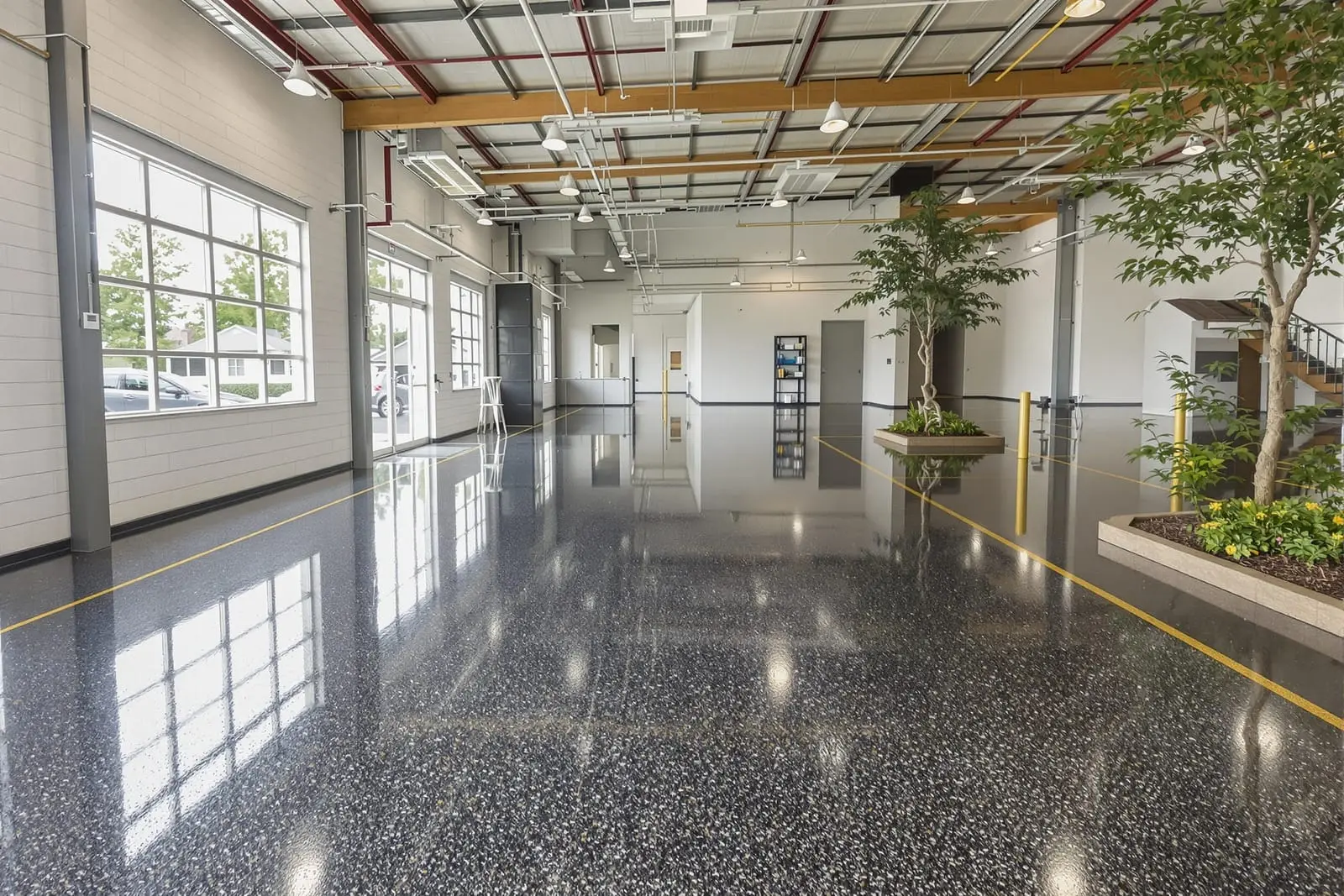
If you need brighter, cleaner spaces, we can polish the concrete to various gloss levels. Polished industrial concrete floors reflect light well, which can cut lighting needs and make inventory labels easier to read. They also clean up better in food storage and light manufacturing settings, although we always review your chemical and spill exposure before recommending polish alone.
For areas that see oils, solvents, or constant wet conditions, we may recommend preparing the floor for future epoxy or urethane coatings. That means tighter control of vapor, better joint detailing, and a finishing profile that will accept mechanical grinding later. Even if you do not install a coating on day one, planning for it can save a lot of rework.
We also look at practical details like joint armoring in high traffic aisles, embedded floor drains in wash areas, and edge thickening at dock doors. These small upgrades often cost less than repairing broken edges, spalled joints, and ponding water problems a few years down the road.
What Drives Cost and Schedule for Warehouse Floors in Charlotte
Most owners want to know why one bid for industrial concrete floors is higher or lower than another. We are transparent about what drives your cost and your schedule.
Main cost drivers include slab thickness, reinforcement type, flatness tolerance, and finish or hardener choices. A 6 inch plain slab is cheaper than an 8 inch slab with rebar and dry shake hardener, but it might not perform under tall racking and narrow aisle forklifts. If your operations call for very flat floors for high-bay storage, we need more precise placement and finishing, which takes more time, more experienced crews, and specialized equipment.
Existing site conditions in the Charlotte area also play a big role. If we find soft subgrade, poor drainage, or old fill, we may need extra stone, geotextile, or undercutting. That work adds upfront cost but usually avoids slab movement that can shut down aisles later.
Schedule is shaped by slab size, joint layout, and curing time. We can often phase the work so sections of your warehouse remain active while we replace or add floors. For new construction, we coordinate around steel erection, underground utilities, and weather windows. Proper cure time cannot be rushed without risk, so we explain what equipment can roll when, and where we need temporary protection.
Vanguard Concrete Charlotte will give you a line item breakdown, not a vague lump sum, so you know what you are paying for and where you might adjust scope without hurting long term performance.
Common Problems We Fix and How to Plan Your Project
A lot of our industrial work in Charlotte is fixing issues from older floors. The same problems can be avoided in new builds if they are planned around real world use.
Typical issues we see include curling at slab edges, spalled and broken joints, dusting surfaces that never fully hardened, moisture coming through the floor that ruins coatings, and differential settlement that causes bumps and rocking racks. Many of these problems trace back to poor base prep, weak mixes, rushed finishing, or no vapor control.
When we repair or replace industrial concrete floors, we start by figuring out the actual cause, not just covering the symptom. That may mean cutting out failed panels, installing dowelled joints, adding joint armoring, or reworking base materials. Sometimes we can grind, densify, and re-joint rather than remove the whole slab, which saves time and cost.
Before you start a new warehouse floor project, gather your rack layout, expected equipment weights, wheel types, and any planned coatings or specialty uses. Share future expansion plans as well. Vanguard Concrete Charlotte uses that information to design a floor that fits what you are doing today and gives you options later. Planning around actual operations is the most important step in getting industrial concrete floors that work for the life of your facility, not just the day you pour them.
“
Professional warehouse & industrial concrete floors, done right the first time, quality materials, honest pricing, and results that last.
Vanguard Concrete Charlotte
Warehouse & Industrial Concrete Floors Across Our Service Area