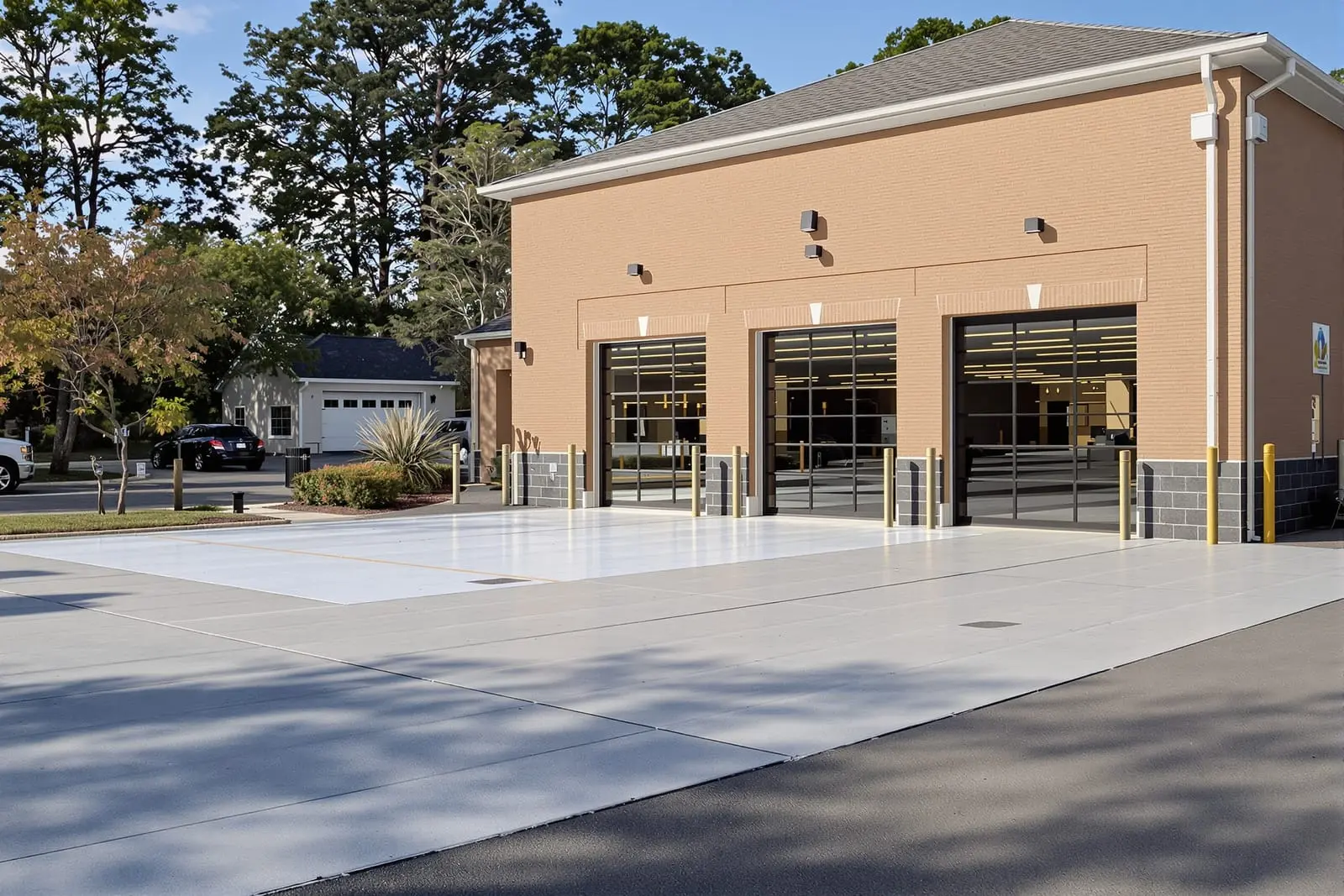
Support heavy equipment and vehicles with a commercial concrete slab in Charlotte, NC. We pour loading docks, dumpster pads, and equipment foundations built for high loads. Our team factors in thickness, reinforcement, and joint layout to resist cracking and settlement. Keep operations safe and efficient with purpose built commercial concrete pads.
Vanguard Concrete Charlotte provides professional commercial concrete slab throughout Charlotte, NC and the surrounding area. Our licensed, insured crew delivers safe, clean, on-time work with a free estimate before anything begins. Call (704) 464-0989 or request your free quote.
Commercial Concrete Slabs Built for Real-World Use in Charlotte
Vanguard Concrete Charlotte designs and installs commercial concrete slabs that are tailored to how your business actually operates, not just what looks good on a set of drawings. For loading docks and high traffic work areas, we pay close attention to the type of equipment you run, the wheel loads, and how trucks maneuver on your site. A slab that works for a light delivery van is not the same slab you need for daily 18 wheeler traffic or forklift lanes.
Charlotte’s climate plays a direct role in how your commercial concrete slab should be built. Our hot summers, clay soils, and occasional freeze thaw cycles can cause poorly designed slabs to crack, curl, or settle. We address that with correct slab thickness, reinforcement, control joint spacing, and proper subgrade prep for Piedmont soils. We also pay attention to drainage so that water does not sit under or against the slab, since standing water is one of the quickest ways to shorten concrete life in this region.
From small service docks behind a retail building to large distribution centers, Vanguard Concrete Charlotte focuses on durability and low maintenance. We explain the structural choices in plain language, so you know what you are paying for and where it matters most. The goal is a slab that stays functional and safe year after year, with minimal downtime for repairs.
How We Build Loading Docks That Hold Up to Heavy Use
A loading dock slab has to manage more than just weight. It must handle repetitive impact from trailers, forklifts braking and turning, and concentrated loads at dock levelers and truck wheels. Our process starts with a site visit where we walk the dock area, study truck paths, and look at how close trailers can back to the building. This lets us identify high stress zones and design the slab thickness, reinforcement, and joint layout around those realities.
For most commercial loading docks in Charlotte, we recommend concrete mixes in the 4,000 to 5,000 psi range, with air entrainment and carefully controlled water content. We often specify thicker concrete (6 inches or more) at wheel paths, dock approach aprons, and in front of dock levelers, sometimes using rebar or heavier welded wire reinforcement in those locations. In high impact areas, we also discuss heavy duty armored joint edges or steel angle protection at the dock face.
We coordinate slab elevations with your dock equipment, doors, and drainage. The approach slab typically needs a slight slope away from the building so rainwater does not run back toward the dock or pond in front of doors. Around older buildings, we often uncover inconsistent existing concrete or poor backfill at the foundation. In those cases, Vanguard Concrete Charlotte can demo and replace problem sections or install compacted stone to create a stable base under the new loading dock slab.
Commercial Slab Installation Step by Step
Transparent process is part of how we work at Vanguard Concrete Charlotte. Before any concrete is ordered, we confirm layout, thickness, reinforcement type, and access routes so you know exactly what will happen on pour day.
First, we remove unsuitable material and proof roll the subgrade. In many Charlotte sites that means cutting out soft clay pockets or old fill and replacing them with compacted crushed stone or gravel. We grade for correct slope and compact until we have a firm, even base. Next, we install edge forms, dowels into existing slabs or foundations where needed, and place reinforcement such as rebar grids or welded wire mesh on proper chairs so it sits in the middle of the slab, not on the dirt.
Concrete placement is scheduled around weather and site access. In summer, we often pour early in the morning to reduce rapid surface drying. We use transit mixers with consistent mix designs, place the concrete, and use vibrators or rodding where necessary around dowels and embedded items. The slab is then screeded to elevation, bull floated, and allowed to set to the right stiffness before we finish it.
Expansion joints at building interfaces and control joints across the slab are cut or tooled to manage cracking. We seal around columns, drains, and dock equipment penetrations. For most commercial slabs, we recommend a curing compound or a wet curing method to help the concrete develop strength and reduce surface dusting. We then keep you informed about when you can walk on and drive on the slab so you can plan operations.
Surface Finishes, Reinforcement Options, and Design Choices
Not every commercial concrete slab should look or perform the same. We help you choose finishes and reinforcement methods based on how your facility runs. For loading docks and exterior truck aprons, a broom finish is usually best. It provides traction for forklifts and truck tires, especially during heavy Charlotte rainstorms. For interiors such as warehouses that tie into the dock area, you might want a harder troweled surface, or even surface hardeners, to resist abrasion and tire marking.
Reinforcement can range from standard welded wire mesh to deformed rebar on a grid, dowel baskets at joint locations, or fiber reinforced concrete that helps control shrinkage cracking. We explain where each method adds value. For example, high traffic dock aprons and trash compactor pads often benefit from rebar because loads concentrate in small areas. By contrast, lightly loaded storage slabs might do well with fiber reinforcement and well spaced control joints, which can be more cost effective.
We also help you think ahead to future changes. If you might add racking, new dock positions, or heavier equipment later, we can upsize the slab or add extra reinforcement in potential upgrade zones now, which is much less costly than replacing concrete later. Vanguard Concrete Charlotte can review your architect’s or engineer’s plans with you and flag any details that may not match how you actually plan to use the space.
What Affects Cost and Schedule for Loading Docks and Commercial Slabs
Budget and timing are critical for most of our commercial clients, so we are direct about what drives cost. The biggest factors are slab thickness, reinforcement type and quantity, the quality of the subgrade, and the size and accessibility of the pour area. Heavy duty loading docks that handle constant semi traffic simply require more concrete, steel, and prep than a light duty service slab.
Existing site conditions around Charlotte can vary a lot. Old asphalt, buried debris, or soft clay zones can add time and excavation costs. On the other hand, if the site has already been properly graded and compacted, we can often move faster and keep costs down. Access for concrete trucks also matters. If we need a concrete pump truck because mixers cannot reach the placement area, that adds a separate line item but might save you time overall.
Weather has a real impact on schedule. In the Carolinas, sudden summer thunderstorms can force us to pause or reschedule if they hit right at pour time. In colder snaps, early morning pours may need extra curing protection. Vanguard Concrete Charlotte plans pours around local forecasts, and we explain any weather related constraints before you commit to specific dates. Our goal is to finish your slab correctly the first time, rather than rushing a pour that could cause scaling or surface issues later.
We work with you to phase the project when needed, such as pouring one dock lane at a time so your operation can keep running. Clear communication about shut down areas, cure times, and equipment return is part of every proposal.
Common Problems We Prevent and How We Help You Plan
Commercial concrete slabs often fail early because of issues that can be avoided with good planning. Typical problems include random cracking in the center of panels, joint spalling where forklift wheels cross, settlement at the dock face, and ponding water against the building. Vanguard Concrete Charlotte addresses each of these in design and installation so you are not dealing with expensive repairs a few years after opening.
We manage cracking risk by using appropriate joint spacing, avoiding overly long or irregular panel shapes, and choosing mix designs that limit shrinkage. At loading docks, we place joints away from the wheel paths or reinforce them with dowels or armored edges so they do not break down under repeated traffic. For areas that tie into older slabs, we carefully consider where to dowel and where to isolate the new concrete so movement can occur without pulling the slab apart.
Drainage is another key focus. We grade slabs to move water toward drains or away from the building, and we consider where downspouts, truck wash areas, or adjacent pavements discharge. In Charlotte’s heavy rain events, a small standing water issue can quickly become a slip hazard and a source of freeze damage in colder nights. We also talk through maintenance practices such as joint sealing, cleaning, and de icing product choices, since some aggressive chemicals can attack concrete over time.
Before you hire any contractor, ask for specifics about subgrade prep, slab thickness, reinforcement layout, and joint details, not just a price per square foot. Vanguard Concrete Charlotte is ready to walk you through our approach, provide references from other local commercial projects, and help you design a loading dock or commercial concrete slab that supports your business for the long term.
“
Professional loading docks & commercial slabs, done right the first time, quality materials, honest pricing, and results that last.
Vanguard Concrete Charlotte
Loading Docks & Commercial Slabs Across Our Service Area