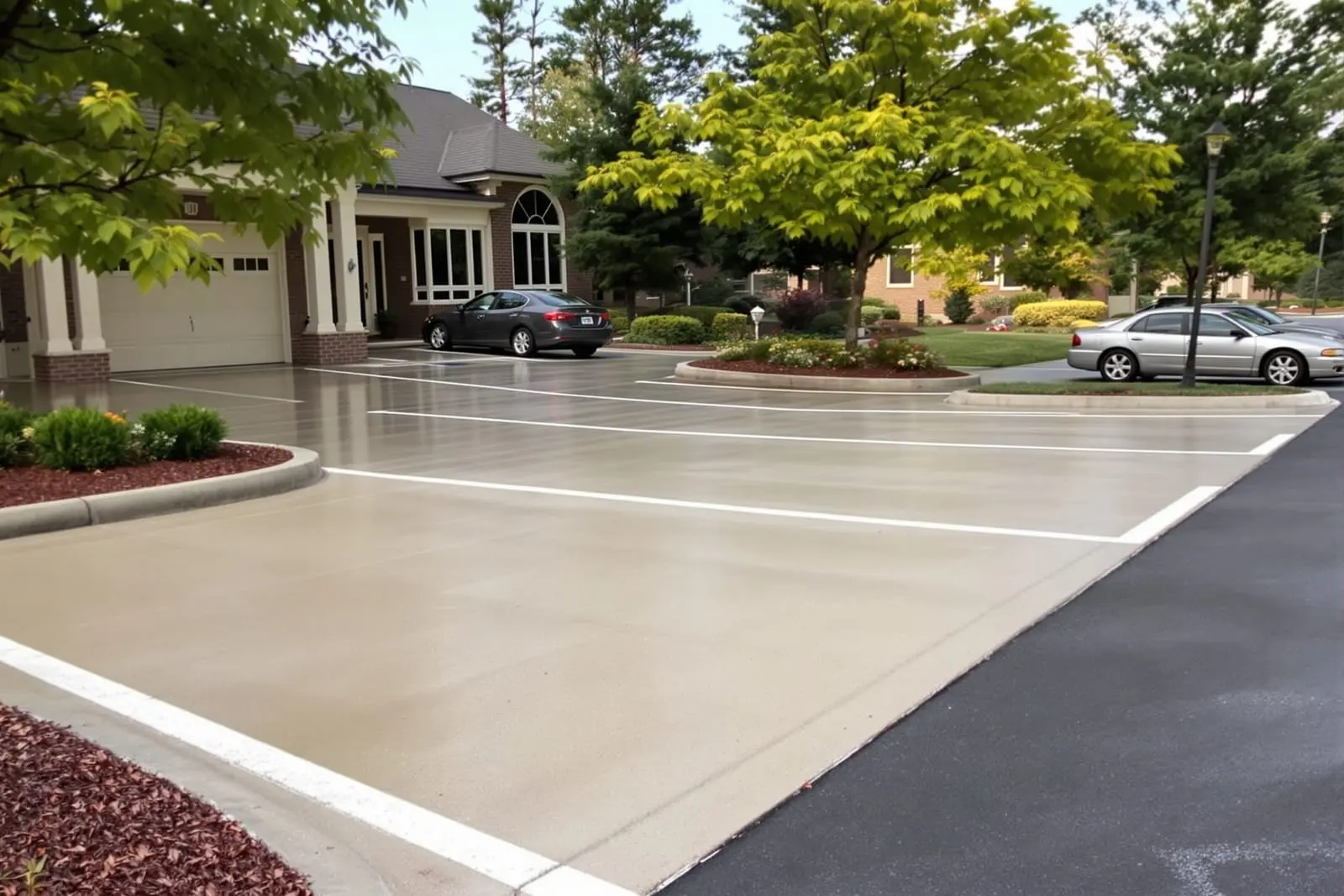
Upgrade your facility with a long lasting concrete parking lot in Charlotte, NC. We handle layout, grading, drainage, and paving for new lots and replacements. Our concrete lots resist rutting and heavy vehicle loads, with clearly defined parking stalls and accessible routes for customers and staff.
Vanguard Concrete Charlotte provides professional concrete parking lot throughout Charlotte, NC and the surrounding area. Our licensed, insured crew delivers safe, clean, on-time work with a free estimate before anything begins. Call (704) 464-0989 or request your free quote.
Concrete Parking Lots Built for Charlotte Traffic and Weather
A concrete parking lot is more than a place to park. It is part of how your business looks and functions every day. At Vanguard Concrete Charlotte, we design and build concrete parking lots that handle heavy traffic, tight urban spaces, and the hot, humid Charlotte climate.
Our crews work across Charlotte and the surrounding areas, from small lots in Plaza Midwood and NoDa to larger commercial sites in South End, University City, and Matthews. We understand the mix of vehicles you see here, including daily commuter traffic, delivery trucks, and rideshare pickups, and we size and reinforce your concrete accordingly.
When you contact Vanguard Concrete Charlotte, we start with a walk of your property. We look at how cars actually move through your lot, where water currently collects, how close you are to neighboring properties, and how fire and trash trucks access the site. This real-world review helps us design a concrete parking lot that solves your specific issues instead of copying a generic layout from somewhere else.
How We Plan Your Concrete Parking Lot Layout
Good parking lot performance starts with layout. Before we talk about concrete thickness, we focus on traffic flow, visibility, and code compliance.
Our team measures your property and maps existing buildings, entrances, and elevation changes. In many Charlotte properties, especially older strip centers on Independence Boulevard or Monroe Road, lots were added years ago without much planning. We often adjust drive lanes and parking angles to meet modern standards and improve maneuverability.
We consider:
• Parking angle and stall size: We choose 60, 45, or 90 degree stalls based on your traffic and how long visitors stay. For quick in and out businesses like coffee shops or convenience stores, we favor layouts that make it easy to pull in and out quickly. Offices and medical practices can often handle 90 degree parking that maximizes total spaces.
• Entrance and exit points: We coordinate with existing curb cuts and city requirements so traffic does not back up onto roads like South Tryon Street or Providence Road. We often recommend a one-way loop around the lot to reduce conflict points.
• Pedestrian routes: We add sidewalk connections, ADA accessible routes, and crosswalks in high foot traffic zones. This is especially important around schools, churches, and medical offices.
The layout plan becomes the basis for grading, drainage design, and concrete pour sequencing, which helps keep your business as open as possible during construction.
Concrete Parking Lot Construction Step by Step
A durable concrete parking lot comes from consistent process, not shortcuts. Vanguard Concrete Charlotte follows a detailed sequence on every project so your lot performs for decades.
1. Demolition and removal: If you have an old asphalt or failing concrete lot, we break and remove it, then haul material to appropriate disposal or recycling sites. We check what is under the old pavement so we know what we are working with.
2. Subgrade evaluation and repair: Charlotte soils vary from red clay to fill material. We compact and proof-roll the subgrade with heavy equipment. Any soft or pumping areas are removed and replaced with compacted stone to prevent future settlement.
3. Aggregate base installation: We place a graded stone base, usually 4 to 8 inches thick depending on load requirements. The base is leveled and compacted in layers. Proper base work is one of the biggest factors in parking lot lifespan.
4. Forming and joint layout: We set forms to control pavement edges and elevations. Our crews mark and plan expansion and contraction joints so the concrete can move with temperature changes without uncontrolled cracking.
5. Reinforcement installation: For most commercial parking lots in Charlotte we use welded wire mesh or rebar reinforcement in heavier load zones. Dumpster pads, loading zones, and drive lanes that see frequent truck traffic receive thicker concrete and additional steel.
6. Concrete placement and finishing: We place air-entrained concrete designed for exterior use, then screed, float, and broom-finish the surface for traction in wet weather. Edges are tooled and joints are cut or sawed at the correct spacing.
7. Curing and strength gain: We apply curing methods that help concrete gain strength evenly. We schedule striping and opening times based on actual conditions so you are not driving on the slab before it is ready.
Every step is documented so you know exactly what is beneath your finished concrete parking lot.
Thickness, Reinforcement, and Mix Design Choices
Not every concrete parking lot needs the same design. Vanguard Concrete Charlotte tailors thickness, reinforcement, and concrete mix to your site and use.
Thickness: For light duty parking such as small offices, salons, or residential overflow lots, 4 to 5 inches of concrete is usually adequate. For most commercial lots with occasional delivery trucks, we recommend 6 inches. Areas with frequent heavy trucks, like loading docks, dumpster pads, and drive lanes for tractor-trailers, often require 7 to 8 inches or more.
Reinforcement: We use different reinforcement approaches depending on your budget and loading. Options include welded wire mesh for general crack control, deformed rebar in grids for heavy-load areas, and additional reinforcement around utility trenches and manholes, which are common failure points in older Charlotte lots.
Concrete mix: Exterior parking lots use air-entrained mixes to resist freeze-thaw cycles that occur during colder snaps in the Charlotte area. We often specify 4000 psi compressive strength mixes for commercial lots, with adjustments for setting time when we are pouring in high summer temperatures. Fibers can be added for extra crack resistance, especially in thinner or cost-sensitive installations.
We explain these choices in plain language, including how each option affects performance, installation schedule, and cost, so you can make an informed decision that fits your business.
Drainage, Slopes, and Charlotte Weather Considerations
Poor drainage is one of the fastest ways to ruin a concrete parking lot. Our designs for Charlotte properties pay close attention to how water moves across and under the pavement.
We set slopes so water flows to inlets or edges without creating standing water where customers walk or step out of vehicles. Typical surface slopes range from 1 percent to 2 percent, enough to drain but not so steep that carts or wheelchairs roll away.
We tie our grading and concrete elevations into existing storm drains, curbs, and sidewalks. For older sites where catch basins are not ideally located, we may recommend adding new inlets or reworking small areas of the storm system. Doing this during a parking lot rebuild is usually less expensive than dealing with ongoing puddles and freeze-thaw damage later.
Charlotte often sees heavy summer storms followed by intense sun. That pattern can stress concrete surfaces. To manage this, we:
• Use control joints at proper spacing to limit random cracking.
• Recommend lighter concrete colors or sealers to reduce surface heat when appropriate.
• Ensure downspouts, roof drains, and adjacent landscaping do not dump water directly at the pavement edge, which leads to undermining and edge failures.
By addressing drainage and transitions up front, your concrete parking lot stays safer, looks better, and needs fewer repairs over time.
Budget, Timing, and What Drives Cost
Understanding what affects the cost of a concrete parking lot helps you plan ahead. Vanguard Concrete Charlotte is transparent about the main drivers so there are fewer surprises.
Key cost factors include:
• Size and thickness: Concrete is priced by the cubic yard. A thicker section for heavy trucks costs more than a thinner car-only lot, but may save money in long-term repairs.
• Site conditions: Soft subgrade, poor access for trucks, or the need to relocate utilities adds labor and material cost. Lots behind tight buildings in neighborhoods like Dilworth or Elizabeth often require more hand work than open suburban sites.
• Demolition and disposal: Removing old asphalt, unsuitable fill, or underground obstructions increases project scope. Recycling options can reduce dump fees on some projects.
• Drainage improvements: New curb, gutter, catch basins, or storm piping adds cost but often prevents future failures.
• Phasing and business operations: If your lot must stay partially open, we can phase work in sections. This requires more mobilizations and often some temporary striping or signage, but protects your revenue during construction.
We provide written proposals that break out major components so you can see what you are paying for. For many Charlotte businesses, we also help plan the best time of year and time of week to schedule the work so impact on customers and staff is minimized.
Repairs, Replacement, and Long-Term Care
If your existing concrete parking lot in Charlotte is showing wear, Vanguard Concrete Charlotte can help you decide whether targeted repairs or full replacement is the smarter move.
Common problems we evaluate include:
• Isolated cracks and spalls: Often repairable with partial-depth patching, joint sealing, and small slab replacements. This is common near dumpster pads or at curb returns where turning forces are highest.
• Widespread settlement or pumping slabs: Usually indicates subgrade or base failure. In these cases, replacing sections and rebuilding the base is more effective than surface-only fixes.
• Drainage-related deterioration: Regrading, adding drains, or adjusting slopes may be needed before new concrete is installed.
For lots that are structurally sound but worn, we may recommend cleaning, joint resealing, and re-striping. Clear markings and refreshed wheel stops can significantly improve safety and appearance at lower cost.
To extend the life of a new concrete parking lot, we suggest a simple maintenance plan: periodic cleaning to remove sand and debris, prompt oil and chemical spill cleanup, joint inspection and sealing as needed, and regular re-striping so traffic stays organized. Our team can schedule maintenance visits or provide guidance so your staff can manage basic upkeep.
Every project ends with a walkthrough where we explain the work performed, review your joint layout and drainage features, and answer maintenance questions so you know how to protect your investment.
“
Professional parking lot concrete, done right the first time, quality materials, honest pricing, and results that last.