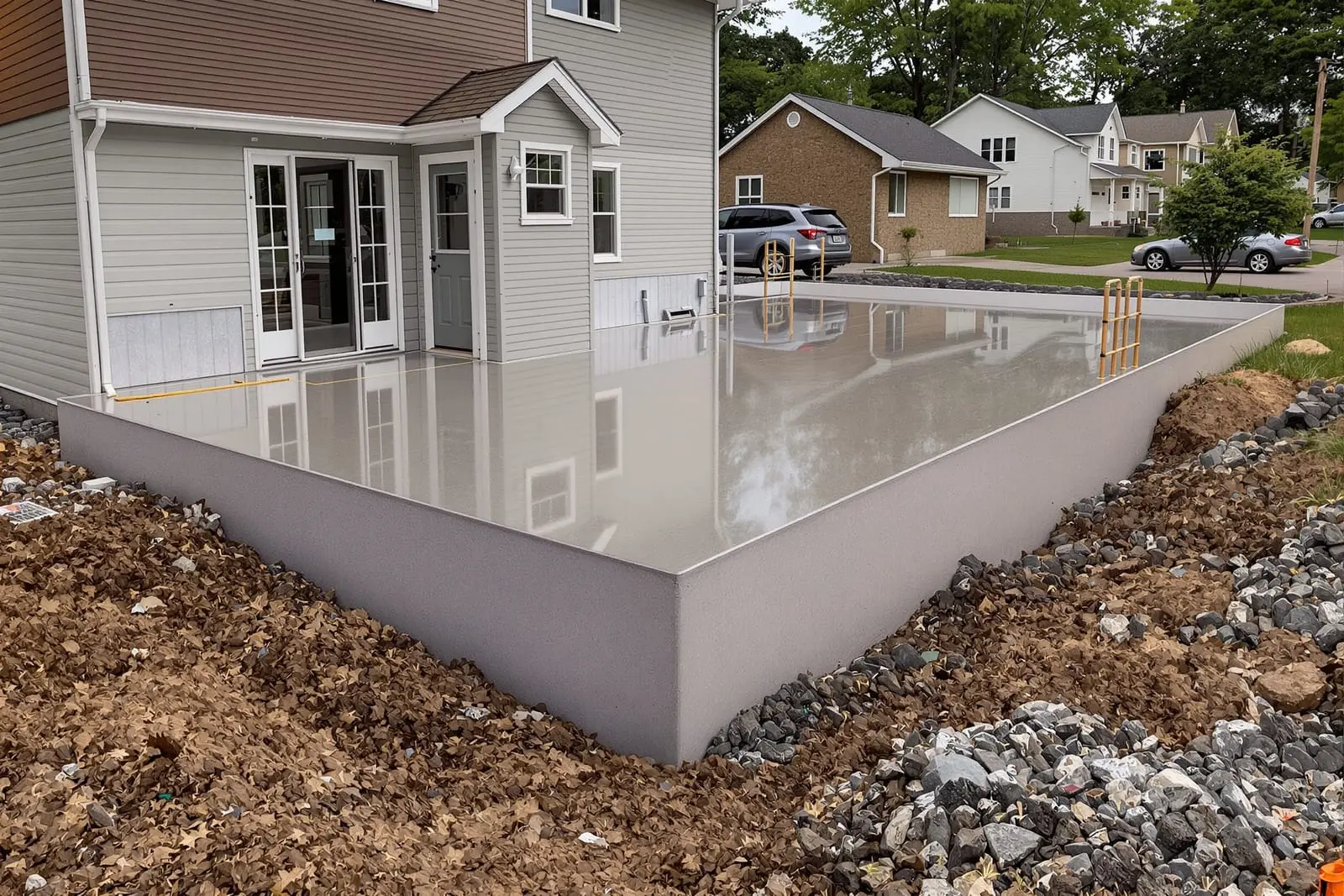
Support your building with engineered commercial concrete foundations in Charlotte, NC. We excavate, form, reinforce, and pour footings and grade beams for offices, retail, and light industrial projects. Our crews follow plans, work with engineers, and maintain schedules to keep your project moving.
Vanguard Concrete Charlotte provides professional commercial concrete foundations throughout Charlotte, NC and the surrounding area. Our licensed, insured crew delivers safe, clean, on-time work with a free estimate before anything begins. Call (704) 464-0989 or request your free quote.
Commercial Concrete Foundations Built For Charlotte Loads And Soils
Commercial concrete foundations in Charlotte are not just bigger versions of residential slabs. They carry heavier point loads from steel columns, support long masonry walls, and have to deal with our Piedmont clays that shrink and swell with moisture. Vanguard Concrete Charlotte designs and installs commercial foundations and footings that are engineered for these specific conditions, not a one-size-fits-all layout pulled from a book.
We start every foundation job with a clear load path. That means confirming how the weight of your structure moves from roof to slab to soil. For tilt wall, retail shells, multi bay warehouses, churches, small medical offices, or tenant upfits in existing shells, we review your structural drawings, clarify column and wall loads, and coordinate anchor bolt, dowel, and blockout locations with your steel and masonry trades. This is what prevents slab cracking at column lines and stops doors from binding as the building settles.
Local knowledge matters in Charlotte because soil changes quickly between sites. A project in South End may sit on urban fill, while a job in Concord or Huntersville might be on firm residual clay with scattered rock. Vanguard Concrete Charlotte works off geotechnical reports when they are available, and when they are not, we coordinate proof rolling, test pits, or third party density testing to verify your building pad before we place a yard of concrete. That extra step is usually far cheaper than fixing a settled foundation later.
How We Install Commercial Concrete Foundations And Footings
On a typical commercial project, our work starts after the site contractor completes rough grading and utilities. Vanguard Concrete Charlotte lays out footing lines from your control points with a total station or tape and transit, then checks them against your architectural grid. We do not dig until offsets and elevations are verified, because moving a line of footings even a few inches later can delay steel erection.
Excavation for strip footings, isolated spread footings, and grade beams follows the engineered sizes and depths. In our region, that often means getting below the organic top layer into firm red clay. For retrofit work or urban infill, we hand dig near existing structures and utilities to avoid undermining them. Once excavated, we place and compact a granular base where required, then set formwork only where the soil will not stand on its own.
Reinforcing steel is tied per the structural drawings, with attention to proper lap lengths, bar chairs, and clear cover so rebar is fully embedded and protected. Charlotte inspectors routinely check bar size and spacing, so we pre check mats and cages before calling for inspection. Anchor bolts, column templates, hold downs, and embedded plates are set to actual grid dimensions, not just tape measurements, so your steel erector can place columns without cutting or torching.
Before any concrete is poured, Vanguard Concrete Charlotte performs a pre pour walk with your superintendent. We verify elevation benchmarks, slab recesses for freezers or pits, slope transitions, and openings for plumbing or electrical. Only when everyone signs off do we order concrete, which keeps change orders and cut and patch work to a minimum.
Concrete Mixes, Finishes, And Options For Commercial Foundations
Concrete for commercial foundations in Charlotte has to meet both strength and durability requirements. Most engineered foundations in our area call for 3000 to 4000 psi mixes, sometimes higher around heavy equipment pads, stair towers, or elevator pits. Vanguard Concrete Charlotte works with local ready mix suppliers that understand DOT and commercial specs, and we match the mix design to your project needs and schedule.
For foundations that will remain exposed to the weather, such as dock walls, retaining foundation walls, or exterior equipment pads, we often recommend air entrained concrete to better handle freeze thaw cycles. For interior slabs supporting racks or machinery, we may look at lower water cement ratios, mid range water reducers, and sometimes fiber reinforcement to help with shrinkage control. These details affect cost, pumpability, and finishing time, so we explain the tradeoffs before the pour.
Finishes for commercial foundations and footings are usually functional rather than decorative, but they still matter. Top surfaces of walls that will receive structural steel or framing are screeded and steel troweled for flatness so base plates bear evenly. Pier tops are checked with laser levels and adjusted while concrete is still plastic. Where foundations step with sloping grades, we form clean vertical faces so waterproofing, foam board, and drainage mats can be installed tight to the concrete.
We also coordinate vapor barriers, insulation, and thickened slab edges when the foundation and slab-on-grade are poured together. Projects like conditioned warehouses, breweries, and medical spaces in Charlotte often need a continuous vapor barrier and, in some cases, underslab insulation. Getting those details right at the foundation stage prevents moisture issues that can damage flooring and equipment down the road.
Cost Drivers, Scheduling, And Common Foundation Problems
On commercial concrete foundations, cost is driven less by square footage and more by complexity. Depth and width of footings, the amount of reinforcing steel, the number of isolated pads and thickened areas, and site access all play a larger role than the overall footprint. Vanguard Concrete Charlotte breaks its proposals out by footing type and slab area so owners and GCs can see where the money is going and where design changes might save cost without hurting performance.
Rock excavation is a common hidden cost in the Charlotte region, especially on ridge lines and older sites. We discuss how your geotechnical report handles potential rock, whether unit prices for rock removal make sense, and how blasting or hydraulic hammers might impact your neighbors and schedule. Poor subgrade conditions, such as undocumented fill or saturated clay, are another frequent issue. When we encounter those in the footing trench, our crews stop and document conditions, then work with your engineer to approve undercuts, stone replacement, or geo grid instead of just pouring on bad ground.
Scheduling is usually tight on commercial projects. Foundations need to be ready for steel or framing on a set date. We build schedules that sequence footing pours, stem walls, and slab areas so other trades can start sooner. For example, elevator pits and stair tower foundations might be poured first so those cores can go up even while other footings are still being formed. Weather is always a factor in Charlotte, especially winter rain and summer heat, so we plan for protection, accelerators, or night pours when high temperatures make finishing difficult.
Common problems on commercial foundations include mislocated anchor bolts, inconsistent elevations, and shrinkage cracking around column pads. Vanguard Concrete Charlotte reduces these issues with templates, laser level checks, and proper joint layout. If cracking does occur, we evaluate whether it is structural or cosmetic, then propose realistic repairs like epoxy injection, dowel and patch, or additional thickening instead of knee jerk full replacement that may not be necessary.
Why Local Experience Matters For Charlotte Commercial Projects
From uptown infill projects to suburban retail centers in Ballantyne, Steele Creek, or University City, each part of the Charlotte area has different site constraints, permitting requirements, and inspection habits. Vanguard Concrete Charlotte works regularly with local building inspectors and understands what they look for on footing and foundation inspections. That familiarity keeps re inspections and surprise delays to a minimum.
Existing utilities, adjacent structures, and tight access are common on urban and renovation projects. We plan concrete pump locations, truck staging, and hose runs so sidewalks, neighbors, and active businesses are not blocked any longer than necessary. For occupied sites, such as hospital campuses or operating warehouses, we can schedule pours early or late in the day to limit disruption, and we coordinate noise and vibration when excavation or sawcutting is involved.
For owners and developers, one of the most valuable things a local concrete contractor can offer is clear advice before the design is locked in. If you involve Vanguard Concrete Charlotte early, we can flag details that routinely cause cost overruns in this market, such as excessively deep footings in otherwise good soils, overcomplicated thickened slabs where simpler grade beams would work, or slab recesses that conflict with plumbing mains. We are not trying to play engineer, but real world feedback from past Charlotte projects can help your design team make more buildable choices.
At the end of the day, a commercial concrete foundation should quietly do its job for decades. That only happens when layout, soil prep, reinforcing, and concrete placement all line up. Vanguard Concrete Charlotte focuses on those fundamentals so your building, equipment, and tenants sit on a foundation that will support them without costly movement or repairs later.
“
Professional commercial concrete foundations & footings, done right the first time, quality materials, honest pricing, and results that last.
Vanguard Concrete Charlotte
Commercial Concrete Foundations & Footings Across Our Service Area